


The Housing Problem Nobody in Concord Could Crack
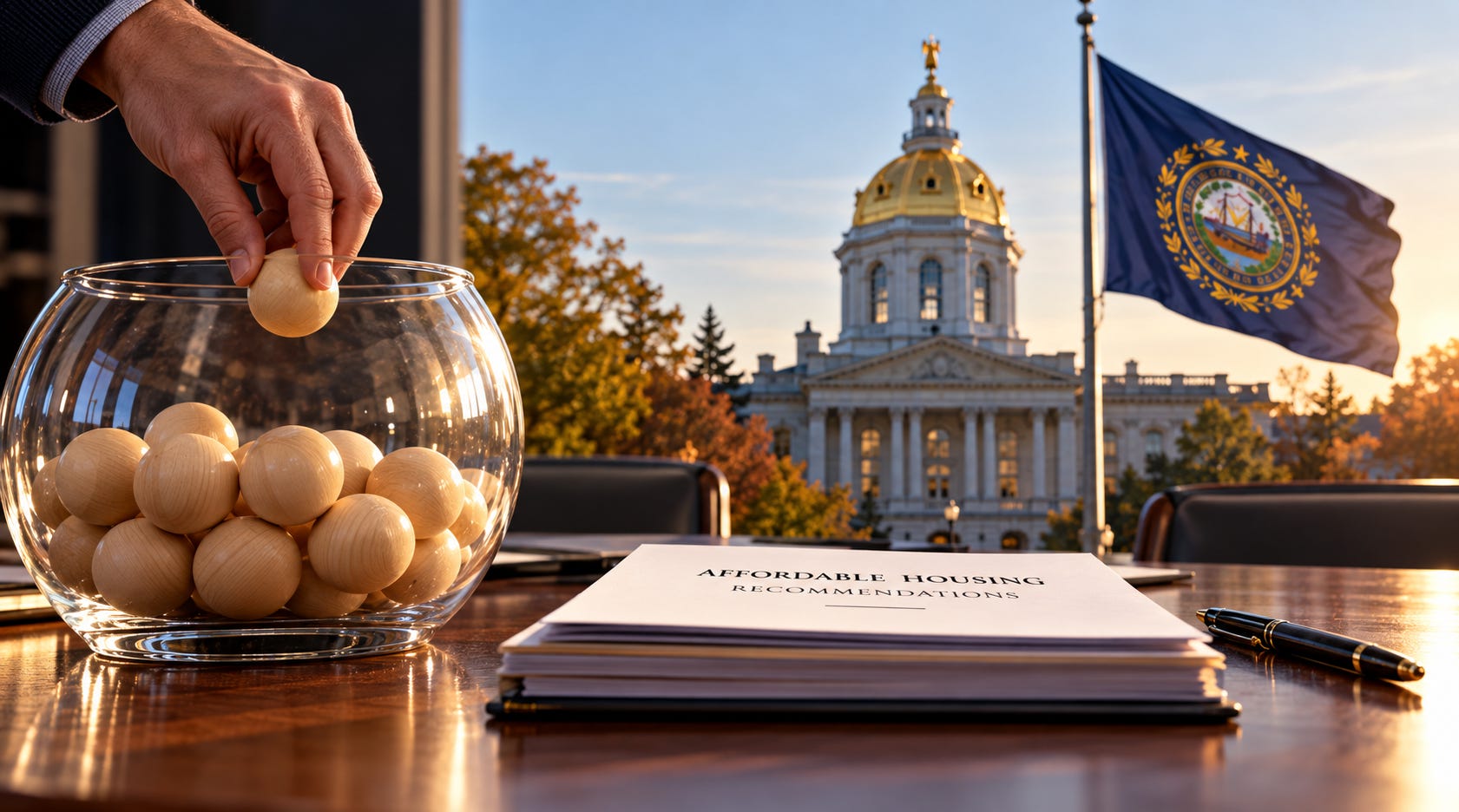
New Hampshire’s legislature argued over affordable housing for years and passed almost nothing. Then a nonprofit did something almost embarrassingly simple: it picked 56 ordinary residents out of a hat — a blind lottery, not a poll or an application — Democrats, Republicans, and independents alike, put them in a room in Concord for three days, and asked them to fix it. They came back with six specific proposals, each backed by at least 70 percent of the room. One hit 84. The legislature hadn’t managed that kind of agreement on housing in a decade.
What I Heard at Bard
I was at the Hannah Arendt Center’s forum at Bard College last week, where its Democracy Innovation Hub had a whole track on “sortition” — the old idea, older than modern elections, of filling a civic body by lot instead of by vote. Political theorist Hélène Landemore, who has built a career arguing for it, made the case that random selection produces bodies that look more like the actual public than elected ones do, precisely because nobody has to win a primary or court a donor to get a seat. It’s a compelling argument on paper. It’s a lot more compelling once you watch it actually produce something.
New Hampshire Just Ran the Experiment
That’s exactly what the New Hampshire Forum did, days before I even got to Bard. Founded by actor and entrepreneur Andrew Shue and co-led by a former Republican state representative, Kevin Smith, and a former Democratic Senate president, Donna Soucy, the Forum used that blind lottery to assemble a room that actually matched the state’s politics and demographics — not a self-selected crowd of activists on either side. Smith put it simply afterward: the participants “saw each other as fellow Granite Staters and not Democrats and Republicans.” One of them, Amy Coleman, a Republican whose group’s infrastructure proposal pulled 84 percent support, said it even plainer: “It really wasn’t about who was what.” A bipartisan panel of twelve legislators, six from each party, now decides which of the six proposals become bills when the session opens in January 2027.
The Lesson for Bridge-Builders
Here’s what I’ve been thinking about and something you might consider: sortition doesn’t work because strangers are nicer than politicians. It works because it strips out the incentive structure that makes politicians perform division in the first place. Nobody in that Concord hotel needed to survive a primary challenger or feed a cable-news hit. They just needed to live in New Hampshire and solve a problem they all actually had. That’s a mechanism, not a slogan. And it’s repeatable. The legislature still has to act on what the panel produced, so the real test is still ahead. But the fact that 56 strangers chosen by lot found more consensus on housing in three days than an elected body found in years is exactly the kind of evidence the bridge-building world needs more of. Worth watching closely as more of these panels get tried on harder problems than housing.
Sources: Valley News on the New Hampshire Forum; Bard College on the Arendt Forum.
Another great piece, Will, that I've forwarded to the rest of my Braver Angels Western MA Organizing Team and to friends far and wide.