

Bridge-building is NOT Surrender. Stop Calling It That
You Don't Have to Give Ground to Find Common Ground

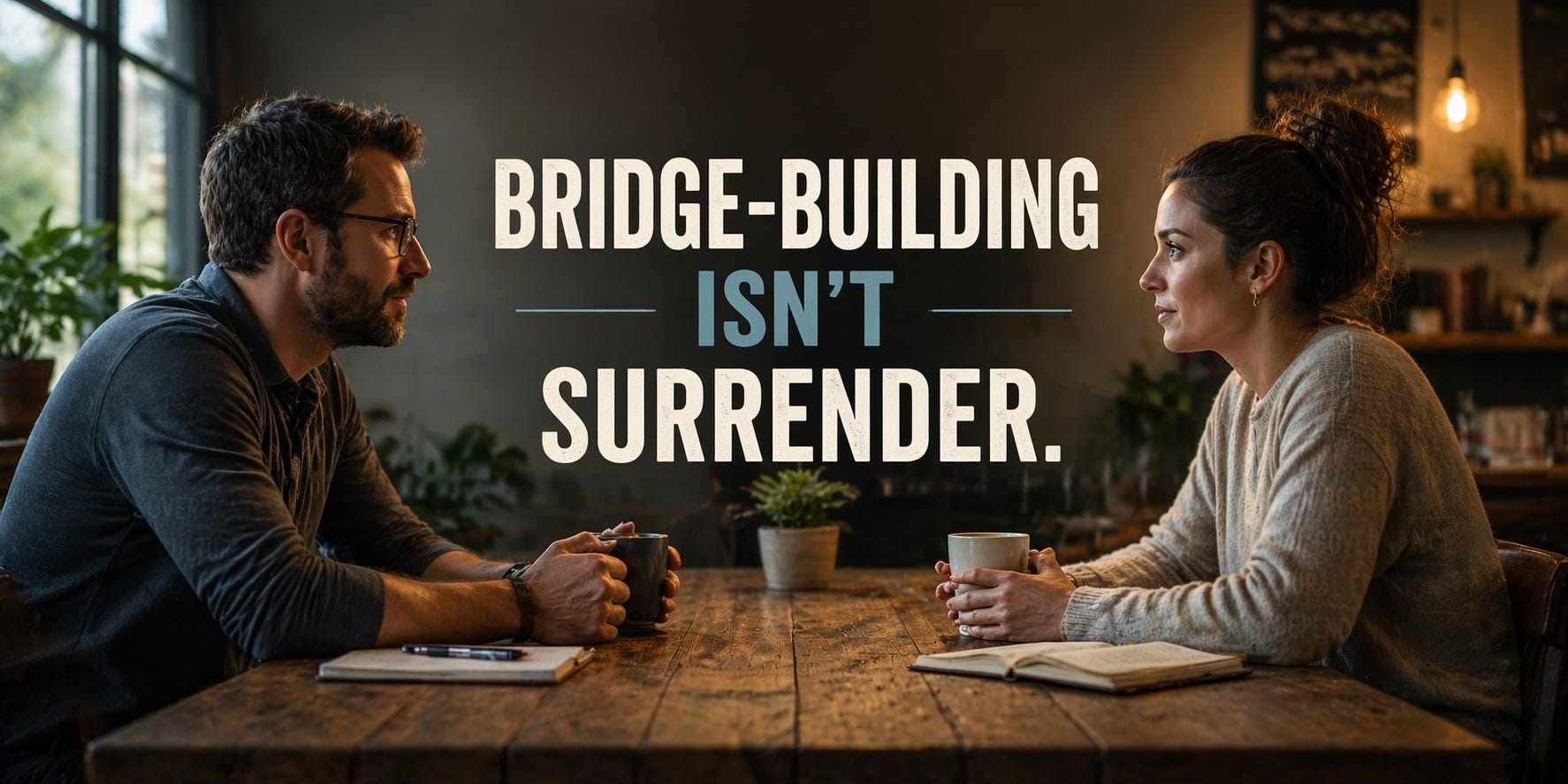
There’s a misconception floating around about the work I do with Braver Angels and through Derate the Hate. It’s not a new one, but a recent op-ed by student journalist Kimball Call brought it back into focus for me, and it deserves a direct response.
Kimball wrote that “movements” like Braver Angels make conservatives feel as though “controversy equals contention.” He’s not alone in thinking that, and honestly, I get where the frustration comes from. But that characterization misses the mark — and it matters that we get this right, because the misunderstanding is doing real damage to a conversation this country desperately needs to have.
Bridge-building is not an invitation to abandon your convictions at the door.
Let me say that plainly: I am a Christian and a conservative. There are positions held by many on the left on which I see no middle ground. None. I’m not here to split the difference on issues of deep moral conviction, and I’m not asking anyone else to. That is not what this work is about.
What I am here to do is disagree accurately. There’s a meaningful difference between finding common ground and landing on middle ground. Common ground doesn’t require you to compromise your values. It just requires you to look for what’s shared while being honest about what isn’t. That’s not weakness. That’s precision.
Abraham Lincoln put it simply: “I don’t like that man. I must get to know him better.” Not agree with him. Not become him. Just know him.
Now, I want to be honest about something. The skeptics of this space aren’t entirely wrong.
There’s a legitimate critique that bridge-building movements have sometimes asked the people who feel most marginalized to calm down and listen, while those with institutional power face no equivalent demand. That the civility ask has been asymmetric. Kimball gestures at this, and it’s where he’s on his firmest ground. For a lot of conservatives, phrases like “let’s find common ground” have historically preceded their concessions, not shared ones. The words have real baggage, earned over time.
There’s also a fair concern about who’s setting the terms. Who decides what “disagreeing accurately” looks like? Who’s running the workshops and writing the frameworks? When the people designing the process lean one direction, “let’s have a civil conversation” can quietly become “let’s have a conversation on our terms.” I’ve seen it happen. It’s a real problem in this space, and those of us in it need to own that.
And then there’s the deepest objection of all: some people believe certain fights shouldn’t be bridge-built. They should be won. That there are moral and constitutional questions where seeking dialogue doesn’t demonstrate good faith, it just legitimizes a position that doesn’t deserve a seat at the table.
I hear all of that. I don’t dismiss it.
But here’s where I land.
Kimball’s piece raises a concern I take seriously: conservative students feel like the bridge-building crowd uses “niceness” as a tool to silence them rather than engage them. And in some corners of this space, that critique is fair. Civility can absolutely be weaponized to shut down ideas. But that’s a misuse of the framework, not the framework itself.
Controversy isn’t the problem. Controversy handled with courage and honesty is healthy. What goes sideways is how the message gets delivered, and whether that delivery serves the actual mission.
I say this often: you cannot hate others into believing what you believe. You cannot shame them into seeing the world your way. If the goal, as Kimball states it, is to feel seen and heard, then the way the message is conveyed matters just as much as the message itself. That’s not a conservative problem or a liberal problem. It’s a human one.
The desire to be seen and heard goes both ways. And this is where the conversation most often breaks down.
If you want people to genuinely hear you, the most reliable path I’ve found is to genuinely listen to them first. Not because you agree. Not because your position is going to change. But because listening with real intention creates the conditions where honest exchange becomes possible.
As we say at Braver Angels: empathy is not agreement. Acknowledgement is not agreement.
You can understand why someone holds a position without endorsing it. You can find the humanity in a person without surrendering your principles. And sometimes, not always but sometimes, when you actually dig into why someone believes what they believe, you find shared concerns underneath the surface disagreement. Maybe even a path neither of you would have found without the conversation.
Teddy Roosevelt had a phrase worth sitting with: “speak softly and carry a big stick.” The stick doesn’t disappear. The conviction doesn’t go anywhere. But how you carry it, and how you choose to enter the room, changes everything about what’s possible.
Bridge-building done right doesn’t ask you to water down your beliefs. It asks you to attack the issue without attacking the person who holds a different position on it. Those are very different things, and confusing them is at the root of a lot of the frustration I hear from people across the spectrum.
The question I always come back to is: what’s the desired outcome? If it’s to win in the moment, to score points, the tools of outrage and contempt might feel satisfying. But if the goal is to actually move the needle? To be understood, and maybe even to understand?
That’s harder work. But it’s the only kind that gets us somewhere real.
Common ground is not middle ground. And finding one doesn’t require surrendering to the other.
Wilk Wilkinson is the host of the Derate the Hate podcast and Director of Media Systems and Operations at Braver Angels. Learn more at DerateTheHate.com.
This topic is a crucial one to navigate for our time. I am grateful to those who write and speak about this topic with concise, clear, and meaningful words that can last. Thank you, Wilk.
With very minor trims:
"You cannot hate others into believing what you believe. You cannot shame them into seeing the world your way. If the goal is to feel seen and heard, then the way the message is conveyed matters just as much as the message itself."
"You can understand why someone holds a position without endorsing it. You can find the humanity in a person without surrendering your principles. And sometimes, not always, when you actually dig into why someone believes what they believe, you find shared concerns underneath the surface disagreement. Maybe even a path neither of you would have found without the conversation."
Allow me to share another quote I would love to get around, written last year by another Braver Angel, Alexandra Hudson:
"A society without disagreement is not united—it is coerced, silent, or stagnant. Difference is not a problem to suppress, but a resource to cultivate. The goal is not to end disagreement, but to build the moral muscle to navigate it together."
I am keeping all of these as regular reminders to apply in my behavior.
Terrific take on why bridge-building is so important to our collective future. It's also a wonderful introduction to the work we do at Braver Angels. Well done!